 JILIAPP 996
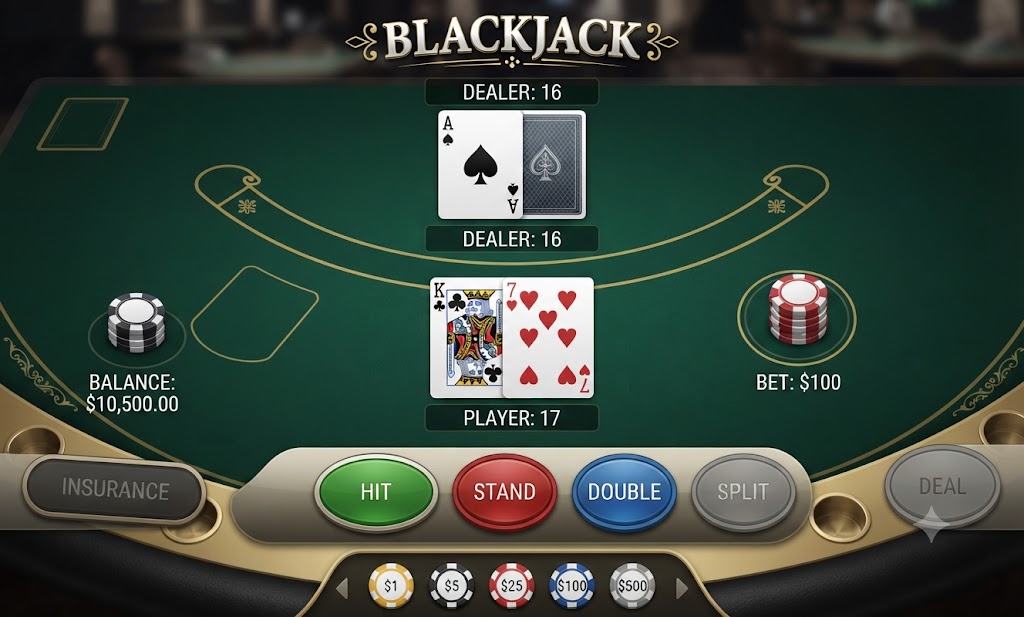
If you're wondering "what is the basic blackjack strategy chart for beginners?", you're asking the single most important question for anyone learning to play blackjack. The basic strategy chart is a mathematically proven guide that tells you the optimal decision — hit, stand, double down, or split — for every possible hand combination against every possible dealer upcard. It's the foundation of winning blackjack play, and even if you only memorize the most common situations, you'll significantly reduce the house edge.
💡 Key Concept: Basic strategy doesn't guarantee you'll win every hand. It guarantees you're making the mathematically correct decision in every situation, which reduces the house edge to the absolute minimum.
Understanding the Four Basic Actions
Before diving into the chart, it's essential to understand the four actions you can take in blackjack:
- Hit: Request another card. You should hit when your current hand is weak and you need to improve it to beat the dealer.
- Stand: Keep your current hand and end your turn. You should stand when your hand is strong enough to beat the dealer's likely hand.
- Double Down: Double your original bet and receive exactly one more card. This is the most powerful move when you have a strong advantage.
- Split: Split a pair into two separate hands, each with its own bet. This is beneficial when the dealer shows a weak upcard.
The Basic Blackjack Strategy Chart
Below is a simplified version of the basic blackjack strategy chart for beginners. It covers the most common situations you'll encounter at the table. The chart is organized by your hand total (rows) and the dealer's upcard (columns).
Hard Hands (No Ace)
| Your Hand | 2 | 3 | 4 | 5 | 6 | 7 | 8 | 9 | 10 | A |
|---|---|---|---|---|---|---|---|---|---|---|
| 17-21 | S | S | S | S | S | S | S | S | S | S |
| 13-16 | S | S | S | S | S | H | H | H | H | H |
| 12 | S | S | S | S | S | H | H | H | H | H |
| 11 | D | D | D | D | D | D | D | D | D | D |
| 10 | D | D | D | D | D | D | D | D | H | H |
| 9 | H | D | D | D | D | H | H | H | H | H |
| 5-8 | H | H | H | H | H | H | H | H | H | H |
Legend: S = Stand, H = Hit, D = Double Down
Soft Hands (With an Ace)
| Your Hand | 2 | 3 | 4 | 5 | 6 | 7 | 8 | 9 | 10 | A |
|---|---|---|---|---|---|---|---|---|---|---|
| A,9 (20) | S | S | S | S | S | S | S | S | S | S |
| A,8 (19) | S | S | S | S | S | S | S | S | S | S |
| A,7 (18) | S | S | S | S | D | S | S | S | S | S |
| A,6 (17) | H | D | D | D | D | H | H | H | H | H |
| A,5 (16) | H | H | D | D | D | H | H | H | H | H |
| A,3-A,4 (14-15) | H | H | D | D | D | H | H | H | H | H |
| A,2 (13) | H | H | D | D | D | H | H | H | H | H |
Legend: S = Stand, H = Hit, D = Double Down
Pairs (When to Split)
| Your Pair | 2 | 3 | 4 | 5 | 6 | 7 | 8 | 9 | 10 | A |
|---|---|---|---|---|---|---|---|---|---|---|
| A,A | SP | SP | SP | SP | SP | SP | SP | SP | SP | SP |
| 10,10 | S | S | S | S | S | S | S | S | S | S |
| 9,9 | SP | SP | SP | SP | SP | S | SP | SP | S | S |
| 8,8 | SP | SP | SP | SP | SP | SP | SP | SP | SP | SP |
| 7,7 | SP | SP | SP | SP | SP | SP | H | H | H | H |
| 6,6 | SP | SP | SP | SP | SP | H | H | H | H | H |
| 5,5 | D | D | D | D | D | D | D | D | H | H |
| 4,4 | H | H | H | SP | SP | H | H | H | H | H |
| 3,3 | SP | SP | SP | SP | SP | SP | H | H | H | H |
| 2,2 | SP | SP | SP | SP | SP | SP | H | H | H | H |
Legend: SP = Split, S = Stand, H = Hit, D = Double Down
How to Read the Strategy Chart
Using the chart is simple once you understand the layout. Find your hand total on the left side of the table and the dealer's upcard across the top. The intersection of the two tells you the optimal move. For example:
- If you have a hard 12 and the dealer shows a 4, the chart says Stand.
- If you have a hard 11 and the dealer shows a 6, the chart says Double Down.
- If you have a pair of 8s and the dealer shows a 7, the chart says Split.
Why Basic Strategy Works
Basic strategy is based on millions of computer simulations that analyzed every possible blackjack hand combination. The strategy chart represents the mathematically optimal decision for each situation, minimizing the house edge to around 0.5%. Without basic strategy, the house edge can be as high as 2-5%, depending on the rules. By following the chart, you're not guessing — you're making the same decision a computer would make to maximize your chances over the long run.
Bankroll Tips for Blackjack
Even with perfect basic strategy, you need to manage your bankroll wisely. Here are some essential tips for blackjack players:
- Set a Budget: Decide how much you're willing to lose before you start playing and stick to it.
- Use a Betting Unit: Bet only a small percentage (1-2%) of your total bankroll per hand to survive losing streaks.
- Avoid Insurance: Insurance is a side bet that mathematically favors the house. Skip it unless you're counting cards.
- Don't Chase Losses: If you're on a losing streak, take a break. Increasing bets to recover losses is a dangerous habit.
- Walk Away When Ahead: Set a winning goal and stop playing when you reach it. It's better to leave with a profit than to give it back.
Practice Makes Perfect
The basic strategy chart might seem overwhelming at first, but you don't need to memorize it all at once. Start with the most common situations — hard hands 12-16, soft hands A-6 through A-8, and pairs. As you play more, the decisions will become second nature. Many online casinos, including JILIAPP 996, offer free play modes where you can practice basic strategy without risking real money.
🃏 Play Blackjack at JILIAPP 996